
Natural growing conditions
Rajasthan's dry winter climate with cool nights and bright days naturally produces tight, white curds with excellent density.
VegTradeHub supplies export-quality cauliflower with snow-white curds, uniform head sizing, and reliable cold-chain logistics — serving processors, wholesale distributors, and institutional kitchens across 25+ countries.
| Parameter | Specification |
|---|---|
| Common name | Cauliflower, Gobi, Phool Gobhi |
| Botanical name | Brassica oleracea var. botrytis |
| Category | Fresh vegetable (cruciferous) |
| Origin | India (Rajasthan, Jodhpur region) |
| Available forms | Whole heads (trimmed), florets (IQF on request) |
| Growing region | Jodhpur, Pali, Nagaur districts, Rajasthan |
| Harvest season | November to March (peak: December-February) |
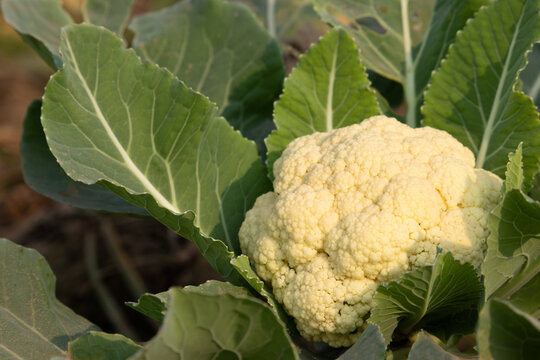
Rajasthan's dry winter climate — cool nights, abundant sunshine, and low humidity — creates ideal conditions for cauliflower curd development. The Jodhpur region produces heads with tight, compact curds and a characteristic snow-white appearance that meets the visual standards of premium export markets and processing buyers.
VegTradeHub works directly with grower groups in Jodhpur, Pali, and Nagaur districts who follow disciplined agronomic practices: variety selection for curd density and color retention, timed transplanting to align harvest with peak winter conditions, and careful nutrient management to avoid hollow stems or ricey curds. The result is cauliflower that holds its structure through harvest, grading, packing, and long-distance transit.
Rajasthan's dry winter climate with cool nights and bright days naturally produces tight, white curds with excellent density.
Sourced from vetted growers in Jodhpur, Pali, and Nagaur districts following good agricultural practices.
Heads harvested at peak maturity when curds are fully developed, compact, and before any discoloration begins.
Sorted by head diameter, curd compactness, color uniformity, and freedom from bracts or ricing.
Meets international phytosanitary standards — clean, sound, pest-free, and suitable for long transit.
Forced-air cooled after harvest; maintained through refrigerated transport to port or airport.
Minimized harvest-to-pack intervals preserve turgidity, crisp texture, and nutritional value.
Snow-white curds with tight bead structure, minimal bracts, and clean wrapper leaves.
Commercial grades with tight diameter tolerances for processing lines and retail uniformity.
The Jodhpur region experiences a distinct winter season (November-March) with daytime temperatures of 20-25°C and night temperatures dropping to 5-10°C. This diurnal range is optimal for cauliflower curd initiation and development — cool nights slow respiration and promote sugar accumulation, while sunny days drive photosynthesis for dense, heavy heads. Low humidity reduces disease pressure from downy mildew and alternaria, minimizing the need for protective sprays and supporting cleaner produce for export.
The region's well-drained sandy loam to loam soils, with pH 6.5-7.5 and good organic matter content, provide ideal structure for cauliflower's shallow root system. These soils warm quickly in winter sun, promoting early root establishment after transplanting, while their drainage prevents waterlogging during occasional winter rains — a key factor in avoiding root rot and maintaining curd hygiene. Calcium availability in these soils supports strong cell walls, contributing to curd firmness and reduced physiological disorders.
Generations of farmers in the Marwar region have refined cauliflower cultivation practices suited to local conditions: precise transplanting windows (mid-September to October) to align curd formation with the coldest weeks, variety selection favoring heat-tolerant early types and cold-tolerant main-season types, and integrated nutrient management combining organic manures with targeted mineral nutrition. This accumulated knowledge translates into consistent curd quality — uniform size, minimal bracting, and the characteristic snow-white color that buyers associate with Rajasthan-origin cauliflower.
Jodhpur's strategic location offers multi-modal export connectivity: Jodhpur Airport (JDH) with daily flights to Delhi and Mumbai for air freight uplift to Middle East and Southeast Asia; Jaipur International Airport (JAI), 330 km away, with wider international cargo options; Mundra and Pipavav ports (450-500 km) for sea freight reefer containers via dedicated highway corridors; and the North Western Railway network for domestic rail freight to container depots. This infrastructure enables flexible shipping — air for high-value early/late season, sea for peak-season volume — with transit times that preserve curd quality.
| Parameter | Grade A (Premium) | Grade B (Standard) | Grade C (Processing) |
|---|---|---|---|
| Head diameter | 15-18 cm | 12-15 cm | 10-14 cm (variable) |
| Head weight | 800-1200 g | 500-800 g | 300-600 g |
| Curd color | Snow white, uniform | White to cream, minor variation | Cream to light yellow, acceptable |
| Curd compactness | Very tight, dense | Tight, good density | Moderate, slight ricey tendency |
| Bracts in curd | None visible | Few, small, at base only | Present, may extend into curd |
| Wrapper leaves | 4-6 fresh, green, protective | 3-5 fresh, green | 2-4, may show age |
| Stem length (trimmed) | 2-3 cm, clean cut | 2-4 cm, clean cut | 3-5 cm, clean cut |
| Surface defects | Zero tolerance | Minor mechanical marks <5% | Up to 10% minor marks |
| Insect damage | Zero tolerance | Zero tolerance | Zero tolerance |
| Decay / rot | Zero tolerance | Zero tolerance | Zero tolerance |
| Packaging | 5 kg / 10 kg corrugated cartons; 20 kg PP mesh bags; custom | ||
| Country of origin | India | ||
| Port of loading | Jodhpur (air), Mundra / Pipavav (sea) | ||
VegTradeHub offers full private-label packaging services for importers, distributors, and retail chains:
| Parameter | Specification |
|---|---|
| Temperature | 0°C to 1°C (32-34°F) — avoid freezing (< -0.5°C causes curd damage) |
| Relative humidity | 95-98% — high humidity prevents moisture loss and curd wilting |
| Air circulation | Continuous, uniform; avoid direct cold air blast on product |
| Ethylene sensitivity | Low — but store separately from high ethylene producers (apples, bananas, tomatoes) to prevent premature yellowing |
| Storage life (optimal) | 3-4 weeks for Grade A; 2-3 weeks for Grade B |
3-4 weeks under proper cold storage (0-1°C, 95-98% RH). Maintains snow-white curds, firm texture, and full flavor — suitable for premium retail and high-end food service.
2-3 weeks under cold storage; minor cosmetic variation (slight cream tint) may develop over time but eating quality and processing yield remain excellent.
1-2 weeks — intended for immediate processing (floretting, freezing, ready meals) soon after arrival. Curd density still suitable for mechanical cutting.
Premium grade cauliflower for wholesale markets, supermarket chains, organic retailers, and specialty distributors. Uniform heads with wrapper leaves intact command shelf presence.
Primary industrial application — Grade A and B heads floretted, blanched, and individually quick frozen (IQF) for retail frozen vegetable packs and food-service supply.
Diced, riced, or pureed for soups, sauces, curry bases, baby food, and prepared meals. Uniform sizing reduces waste on automated cutting lines and ensures consistent cook times.
Hotels, restaurants, catering, and cloud kitchens source for fresh prep — roasting whole, steaming, cauliflower rice, gratin, and garnish applications. Consistent head size enables portion control.
Grade C and processing surplus directed to dehydration lines for cauliflower powder, flour, and ingredient blends used in snacks, bakery, and gluten-free formulations.
Re-export hubs (Dubai, Singapore, Rotterdam) distribute onward to regional markets; VegTradeHub supports documentation, cold-chain coordination, and mixed loads with other Rajasthan winter vegetables.
UAE, Saudi Arabia, Qatar, Oman, Kuwait, Bahrain, Jordan, Lebanon. High demand for premium fresh cauliflower and IQF grades; air freight dominant.
Singapore, Malaysia, Thailand, Indonesia, Philippines, Vietnam, Hong Kong. Growing processing sector and premium retail; sea and air freight.
Netherlands, Germany, UK, France, Belgium, Spain. Seasonal demand (winter gap) for fresh cauliflower with EU MRL compliance; sea freight primary.
Bangladesh, Nepal, Sri Lanka, Maldives. Land and sea connectivity; markets favor processing and wholesale grades; competitive pricing key.
USA, Canada. Air freight for specialty fresh markets; sea freight for processing. USDA APHIS import requirements and cold treatment protocols apply.
Mauritius, Seychelles, South Africa, Kenya, Tanzania. Growing demand via Dubai transshipment or direct from Mundra; mixed loads with other vegetables.
Direct work with grower groups in Jodhpur, Pali, and Nagaur — full traceability to field level.
Track record shipping fresh vegetables to 25+ countries with destination-specific expertise.
Standardized grading, documented QC, and lot-level traceability season after season.
From trial LCL shipments to full-season programs — no rigid minimums.
Harvest-to-load discipline: pre-booked reefer space and priority air cargo slots.
Complete, accurate export documents delivered on time, every shipment.
Transparent cost breakdowns — no hidden margins or surprise charges.
Single point of contact per buyer; responsive across time zones.
Private label, retail-ready, MAP, eco-friendly — adapted to your market needs.
Multi-season supply partnerships with forecast sharing and volume commitments.
Trial orders from approximately 2 MT (one pallet air freight or partial container). Full-container programs start at 18-22 MT with better pricing, priority grading, and dedicated acreage.
Yes — full private-label packaging: custom artwork, multi-language labels, consumer packs (500g-2kg floret packs), retail-ready formats, and modified atmosphere packaging (MAP) on request.
Yes — to 25+ countries across Middle East, Southeast Asia, Europe, South Asia, North America, and Africa. We handle destination-specific phytosanitary and documentation requirements.
Forced-air pre-cooling to 1°C, reefer containers with temperature loggers (real-time or download), arrival temperature verification, and cold-chain SOPs from farm to destination cold room.
Air freight (12-36 hrs), sea reefer (10-28 days), LCL consolidation weekly from Mundra, and land border transport to SAARC countries.
Yes — mixed 40'HC reefers combining cauliflower with cabbage, red carrot, beetroot, red onion, garlic, potato, and other Rajasthan winter vegetables. Optimizes freight cost for buyers.
Select farms are GlobalGAP certified; packhouse operates under HACCP. FSSAI Central License, APEDA RCMC registration, and residue testing per FSSAI/Codex/EU MRLs.
Early booking (August-October) secures best pricing, grades, and dedicated acreage. Forward contracts lock in supply and pricing for the November-March harvest window.
Claims must be reported within 48 hours of arrival with photo evidence and temperature logger data. We investigate within 24 hours and resolve within 7 business days per our quality claim SOP.
Primary supply is whole heads (trimmed with wrapper leaves). Florets and IQF cauliflower available on request from partner processing facilities — minimum volumes apply.