
Optimal Rabi climate
Rajasthan's cool, dry winter with sharp spring temperature rise naturally drives high protein accumulation and strong gluten development in wheat.
VegTradeHub is a B2B wheat supplier sourcing from the fertile Rabi belt across Jodhpur, Pali, and Nagaur districts. We supply export-grade durum wheat, bread wheat, and sharbati varieties to flour mills, pasta manufacturers, bakeries, and food processors worldwide with consistent protein levels, verified moisture specifications, and reliable logistics.
| Parameter | Specification |
|---|---|
| Common name | Gehun, Wheat, Godumai, Godhi, Kanak, Gehun |
| Botanical name | Triticum aestivum (bread wheat), Triticum durum (durum wheat), Triticum aestivum subsp. aestivum (sharbati) |
| Category | Grain commodity, cereal grain, food grain |
| Origin | India (Rajasthan, Jodhpur region) |
| Available forms | Whole grain (cleaned), wheat flour (atta), semolina (suji/rava), durum semolina, bran, wheat germ |
| Growing region | Jodhpur, Pali, Nagaur districts, Rajasthan |
| Harvest season | March to April (Rabi crop, peak: late March) |
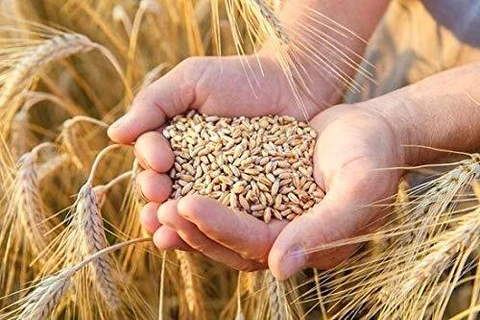
Wheat (Triticum spp.) is the principal Rabi cereal cultivated across the semi-arid districts of western Rajasthan. The Jodhpur-Pali-Nagaur belt produces three commercially significant wheat classes: durum wheat (Triticum durum) with high protein and gluten strength for pasta and semolina; bread wheat (Triticum aestivum) with balanced protein for flour milling and bakery applications; and sharbati wheat, a premium bread wheat variant prized for its golden amber grains, high protein, and superior chapati-making quality. The region's cool, dry winter followed by a sharp temperature rise during grain fill creates ideal conditions for protein accumulation and test weight development.
VegTradeHub works directly with grower groups in Jodhpur, Pali, and Nagaur to deliver export-quality wheat suitable for industrial flour mills, pasta factories, commercial bakeries, and institutional food service. Our grain is professionally cleaned, graded to international standards for protein, moisture, test weight, and falling number, and hygienically packed in food-grade containers. Whether you need durum for semolina production, high-protein bread wheat for artisan bakery, or sharbati for premium atta, our team supports your wheat procurement with transparent specifications, reliable logistics, and complete export documentation.
Rajasthan's cool, dry winter with sharp spring temperature rise naturally drives high protein accumulation and strong gluten development in wheat.
Sourced from vetted growers in Jodhpur, Pali, and Nagaur districts following good agricultural practices and variety purity protocols.
Grain harvested at optimal moisture (10-12%) to preserve test weight, germination, and storage stability.
Multi-stage cleaning removes foreign matter, shriveled kernels, and weed seeds; graded by protein, moisture, test weight, and falling number.
Meets international phytosanitary and food safety standards - clean, sound, pest-free, suitable for international markets.
Variety-specific protein ranges maintained through segregated variety handling and lot-level testing.
Grain conditioned to 12% max moisture for safe long-distance transport and extended storage life.
High hectolitre weight (78-82 kg/hl) indicating dense, well-filled kernels with high milling yield.
Farm records linked to packhouse lot codes for full traceability from field to final load.
Western Rajasthan's Rabi season (November to April) delivers the precise thermal profile wheat needs: cool vegetative growth (15-20°C) for tiller development, followed by a sharp temperature rise during grain fill (25-30°C) that accelerates protein deposition and gluten polymerization. Low winter humidity keeps foliar diseases (rusts, blights) at bay, reducing fungicide use and supporting cleaner grain. The region's abundant sunshine during grain fill drives photosynthesis, filling kernels with starch and protein. This climate consistently produces wheat with protein content of 11-14% (bread wheat) and 13-15% (durum), test weights of 78-82 kg/hl, and falling numbers above 300 seconds.
The light to medium textured sandy-loam soils of the Jodhpur-Pali-Nagaur belt are well-drained, low in salinity, and responsive to irrigation. These soils warm quickly in spring, promoting root activity during critical grain fill. Many fields are irrigated by the Indira Gandhi Canal and tube wells, allowing precise moisture management - critical for achieving target protein levels. The soil's moderate organic matter and neutral pH support nutrient availability without excessive vegetative growth that could dilute grain protein.
Wheat cultivation in the Marwar region spans generations. Growers in Jodhpur, Pali and Nagaur have refined variety selection (HD 2967, DBW 187, HI 8759 for bread wheat; PDW 34, HI 8627 for durum; sharbati selections), sowing windows (early November for timely sown, late November for late sown), and nitrogen management to hit protein targets. VegTradeHub partners with these experienced growers through forward contracts, technical guidance on variety purity and harvest timing, and transparent pricing that rewards protein premiums. This direct relationship supports traceability from individual farm plots to cleaned, graded lots.
Jodhpur's central location in western Rajasthan provides efficient access to multiple transport corridors. Rail freight moves cleaned wheat in covered wagons to major flour milling clusters (Delhi, Mumbai, Ahmedabad, Chennai) and ports. Road transport via NH-62 and NH-25 connects to Mundra and Pipavav ports (8-10 hours) for containerized sea freight. Air freight from Jodhpur/Jaipur serves urgent sample shipments and high-value specialty grades. This multi-modal connectivity lets us tailor logistics to your order size, grade, and destination - whether a 25 MT trial container or a 5,000 MT seasonal program.
| Parameter | Durum Wheat (Premium) | Bread Wheat (Standard) | Sharbati Wheat (Premium) | Processing Grade |
|---|---|---|---|---|
| Protein content (dry basis) | 13.5-15.0% | 11.5-13.0% | 12.5-14.0% | 10.5-12.0% |
| Moisture | 12.0% max | 12.0% max | 12.0% max | 12.5% max |
| Test weight (hectolitre) | 80-82 kg/hl | 78-80 kg/hl | 80-82 kg/hl | 76-78 kg/hl |
| Falling number | 350+ seconds | 300+ seconds | 350+ seconds | 250+ seconds |
| Wet gluten | 32-36% | 28-32% | 30-34% | 25-28% |
| Gluten index | 85-95 | 70-85 | 80-90 | 60-75 |
| Foreign matter | 0.1% max | 0.2% max | 0.1% max | 0.5% max |
| Shriveled/broken kernels | 1.0% max | 2.0% max | 1.0% max | 3.0% max |
| Other food grains | 0.5% max | 1.0% max | 0.5% max | 2.0% max |
| Weed seeds | 0.1% max | 0.2% max | 0.1% max | 0.5% max |
| Insect damage | 0.5% max | 1.0% max | 0.5% max | 1.0% max |
| Packaging | 25 kg / 50 kg PP bags; 500 kg / 1000 kg bulk bags (FIBC); bulk loose in containers | |||
| Country of origin | India | |||
| Port of loading | Mundra / Pipavav (sea); Jodhpur / Jaipur (air for samples) | |||
VegTradeHub offers full private-label packaging services for flour mills, pasta manufacturers, and retail chains:
| Parameter | Specification |
|---|---|
| Temperature | Cool, below 25°C (avoid heat buildup; ideal 10-20°C) |
| Relative humidity | Below 65% RH to prevent moisture absorption and mold growth |
| Air circulation | Continuous, uniform; aeration systems recommended for bulk storage |
| Pest management | Integrated pest management: sanitation, monitoring, phosphine fumigation if needed |
| Storage life | 12-24 months under recommended conditions; longer with aeration and temperature control |
18-24 months under proper dry storage at 10-20°C, <65% RH with aeration. Maintains protein quality, gluten strength, falling number, and germination capacity.
12-18 months under dry storage with aeration. Protein and gluten remain stable; monitor for moisture migration in large bins.
6-12 months - intended for near-term milling. Higher foreign matter and moisture tolerance require more active management.
Bread wheat and sharbati are the primary raw materials for Indian flour mills producing whole wheat atta (chapati flour), refined maida (all-purpose flour), and semolina (suji/rava). Sharbati commands premium pricing for its superior dough extensibility, water absorption, and chapati texture. Consistent protein (11.5-13%) ensures predictable milling yield and flour quality.
Durum wheat (13.5-15% protein, strong gluten index 85-95) is the exclusive raw material for pasta, couscous, and premium semolina. High yellow pigment (carotenoid) content gives pasta its characteristic golden color. VegTradeHub's durum meets international semolina specs for particle size distribution, ash content, and cooking quality.
High-protein bread wheat (12.5-14%) with strong gluten (wet gluten 30-34%, gluten index 80-90) for artisan breads, burger buns, sandwich loaves, and frozen dough. Consistent falling number (350+) ensures stable enzyme activity and predictable fermentation.
Wheat flour and semolina for noodles, pasta ready-meals, bakery mixes, batter & breading systems, and extruded snacks. Uniform protein and particle size reduce waste on automated lines and support consistent product texture.
Hotels, restaurants, catering, canteens, and cloud kitchens source wheat flour, semolina, and specialty products (durum semolina for fresh pasta, sharbati atta for premium rotis). VegTradeHub supports bulk supply with consistent specifications and food-service packaging.
Re-export hubs distribute onward to regional markets; VegTradeHub supports documentation, logistics coordination, and mixed loads combining wheat with other Rajasthan commodities (pulses, spices, oilseeds).
UAE, Saudi Arabia, Qatar, Oman, Kuwait, Bahrain, Jordan, Lebanon, Yemen, Iraq. High demand for durum (pasta), bread wheat (flatbread), and sharbati (premium atta). Major wheat importers with established Indian supply chains.
Indonesia, Malaysia, Philippines, Thailand, Vietnam, Bangladesh, Sri Lanka. Growing wheat milling capacity; demand for bread wheat and durum for noodle and bakery industries.
Egypt, Algeria, Morocco, Tunisia, Libya. Traditional wheat importers; durum for couscous and pasta, bread wheat for subsidized bread programs. Indian wheat competitively priced vs Black Sea origins.
Kenya, Tanzania, Uganda, Ethiopia, Sudan, Mauritius, Seychelles. Growing milling sectors; sea freight from Mundra 10-18 days. Indian wheat preferred for protein consistency.
Nepal, Bhutan, Maldives. Land and sea connectivity; demand for bread wheat and atta. Shorter transit, familiar quality parameters.
Italy, Spain, Turkey (durum for pasta blending); USA, Canada (specialty/organic). Smaller volumes, air freight or containerized. Requires EU/USDA compliance and residue testing.
Direct work with grower groups in Jodhpur, Pali, and Nagaur - full traceability from plot to cleaned lot.
Track record shipping wheat and grains to 25+ countries with destination expertise and seasonal reliability.
Standardized cleaning, documented QC, lot-level protein/moisture/test weight certificates season after season.
From trial 20 MT containers to 50,000 MT bulk vessel programs - scalable to your demand.
Harvest-to-load discipline: pre-booked container space, rail wagons, or vessel slots for Rabi harvest.
Complete, accurate export documents delivered on time - phytosanitary, COO, COA, weight cert, buyer-specific paperwork.
Transparent cost breakdowns (FOB, CFR, CIF) - no hidden margins, fair pricing for both small and large buyers.
Single point of contact per buyer; responsive across time zones with WhatsApp-first communication.
Private label, retail packs, FIBC, bulk loose - adapted to mill, bakery, or retail specifications.
Multi-season supply partnerships with forecast sharing, volume commitments, and forward price contracts.
Trial orders from 20 MT (one 20' container). Full-season programs start at 500 MT with better pricing, dedicated acreage, and priority grading.
Yes - we segregate by variety and protein band. Durum 13.5-15%, bread wheat 11.5-13%, sharbati 12.5-14%. Lot-level protein certificates provided with each shipment.
Yes - durum wheat (Triticum durum) with 13.5-15% protein, strong gluten index (85-95), high yellow pigment, and falling number 350+ is our core export grade for semolina and pasta mills worldwide.
Sharbati is a premium bread wheat variant with golden amber grains, higher protein (12.5-14%), superior dough extensibility, and exceptional chapati/roti making quality. It commands a price premium over standard bread wheat.
Grain loaded at 12% max moisture, container desiccants on humid routes, ventilated containers, temperature monitoring, and arrival inspection with independent surveyor verification.
Yes - mixed 20'/40' containers combining wheat with chickpeas (chana), moong dal, cumin (cumin seeds), coriander, mustard, and other Rajasthan Rabi crops from the same harvest window.
FSSAI Central License, APEDA RCMC, ISO 22000/HACCP food safety system, and residue testing per FSSAI/Codex/EU MRLs for pesticides, heavy metals, and mycotoxins.
Early booking (October-December) secures best pricing, variety allocation, and dedicated acreage. Forward contracts lock in supply, protein specs, and pricing before harvest (March-April).
Claims must be reported within 7 days of arrival with independent surveyor report, photos, and lab analysis. We investigate within 48 hours and resolve within 10 business days per contract terms.