
Superior storage life
High dry matter and tight skin retention deliver 4–6 month cold-storage capability — ideal for long-haul sea freight.
VegTradeHub supplies export-quality red onions from Jodhpur, Pali, and Nagaur districts — India's premier storage onion region. Bulk supply for importers, distributors, processors, and institutional kitchens with cold-chain logistics, phytosanitary certification, and flexible grading programs.
| Parameter | Specification |
|---|---|
| Common name | Red Onion, Lal Pyaz, Storage Onion |
| Botanical name | Allium cepa var. cepa (Aggregatum group) |
| Category | Fresh vegetable (bulb onion) |
| Origin | India (Rajasthan: Jodhpur, Pali, Nagaur districts) |
| Available forms | Fresh whole bulbs, peeled cloves, dehydrated flakes, onion powder |
| Growing region | Jodhpur, Pali, Nagaur districts, Rajasthan (Marwar onion belt) |
| Harvest season | Rabi: November–March (main crop); Kharif: March–May (secondary) |
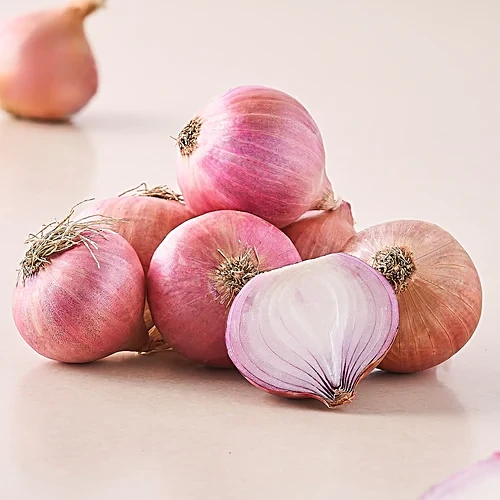
Rajasthan's Marwar region — spanning Jodhpur, Pali, and Nagaur — is India's premier storage onion belt. The arid climate, well-drained sandy-loam soils, and pronounced diurnal temperature variation produce red onions with high dry matter content, intense pungency, and exceptional keeping quality. These attributes make Rajasthan red onions the preferred choice for long-distance export, cold-storage programs, and industrial processing where shelf stability is critical.
VegTradeHub works directly with farmer collectives across the onion belt, coordinating harvest timing, field curing, and post-harvest handling to deliver bulbs that meet stringent export specifications. Our supply chain integrates farm-level grading, packhouse sorting, pre-cooling, and reefer dispatch — ensuring consistent quality from field to destination port.
High dry matter and tight skin retention deliver 4–6 month cold-storage capability — ideal for long-haul sea freight.
Sourced from vetted growers in Jodhpur, Pali, and Nagaur following integrated pest management and good agricultural practices.
Bulbs lifted at full physiological maturity when solids content and pungency peak, ensuring maximum storage potential.
Field-cured 7–10 days, then mechanically and manually graded by diameter, skin integrity, and neck closure.
Meets international standards — clean, sound, pest-free, with phytosanitary certificate issued by PPQS, Government of India.
Forced-air pre-cooling within 4 hours of harvest; maintained at 0–2°C through reefer transport to port of loading.
Tight diameter tolerances (±5 mm) and uniform skin color reduce processing waste and improve retail presentation.
Three commercial grades (Premium, Standard, Processing) with defined specs — match quality to your market and margin.
The Marwar region experiences hot, dry summers (35–45°C) and cool winters (5–15°C) with low humidity (20–40%) and negligible rainfall during the Rabi onion season. This climate suppresses foliar diseases (purple blotch, Stemphylium blight) and reduces bulb rot pressure, producing clean, disease-free onions with high solids content. The intense sunlight drives photosynthesis and dry matter accumulation, while cool nights slow respiration — a combination that naturally enhances storability and pungency.
Predominantly deep, well-drained sandy loam to loamy sand soils (Typic Torripsamments / Typic Haplocalcids) with pH 7.5–8.2 and low organic carbon (0.3–0.6%). These soils promote rapid bulb expansion, easy harvest with minimal mechanical damage, and excellent skin set. Low clay content reduces soil adhesion on bulbs, lowering post-harvest cleaning costs and improving pack-out appearance.
Generations of onion cultivation in the Marwar belt have refined varietal selection (N-53, Bhima Super, Arka Niketan, Baswant 780), seed production, transplanting schedules, and curing techniques. Farmers practice raised-bed planting with drip irrigation, precision fertilizer scheduling, and staged harvesting — knowledge systems that consistently deliver export-grade yields of 25–35 MT/ha. VegTradeHub partners with progressive grower groups who maintain field records, enabling lot-level traceability.
Jodhpur Airport (JDH) offers daily cargo capacity to Middle East hubs (Dubai, Doha, Muscat) with 4–6 hour flight times. Mundra and Pipavav ports (280–320 km by road) provide weekly reefer sailings to Southeast Asia, Europe, and North America. The Delhi–Mumbai Industrial Corridor and dedicated freight rail ensure reliable domestic movement to packhouses and ports. This multi-modal connectivity supports both air freight for high-value programs and sea freight for volume shipments.
| Parameter | Grade A (Premium) | Grade B (Standard) | Grade C (Processing) |
|---|---|---|---|
| Bulb diameter | 50–70 mm | 40–80 mm | 30–90 mm |
| Bulb height | 45–60 mm | 35–70 mm | 30–80 mm |
| Skin color | Deep uniform red, glossy | Medium red, slight variation | Light red to pink, variable |
| Flesh color | White with distinct red rings | White with faint red rings | White, minimal ring definition |
| Skin retention | ≥ 3 complete dry scales, tight | ≥ 2 complete scales, mostly tight | 1–2 scales, may be loose |
| Neck closure | Tight, well-dried, ≤ 5 mm | Closed, ≤ 10 mm | Partially open, ≤ 15 mm |
| Root trim | Clean, flush cut | Clean, ≤ 3 mm residual | Trimmed, ≤ 5 mm residual |
| Doubles / multiples | Zero tolerance | ≤ 2% by count | ≤ 5% by count |
| Sprouting / rooting | Zero tolerance | Zero tolerance | Zero tolerance |
| Mechanical damage | Zero tolerance | ≤ 1% (superficial only) | ≤ 3% (including cuts/bruises) |
| Decay / mold | Zero tolerance | Zero tolerance | Zero tolerance |
| Foreign matter | Zero tolerance | Zero tolerance | Zero tolerance |
| Packaging | 5 kg / 10 kg corrugated cartons; 20 kg PP mesh bags; custom | ||
| Country of origin | India | ||
| Port of loading | Jodhpur (air), Mundra / Pipavav (sea) | ||
VegTradeHub offers full private-label packaging services for importers, distributors, and retail chains:
| Parameter | Specification |
|---|---|
| Temperature | 0 to 2°C (32–35.6°F) — avoid freezing (< -1°C causes translucent scales) |
| Relative humidity | 65–75% — lower RH reduces sprouting and root growth; higher RH risks mold |
| Air circulation | Continuous, uniform; 0.5–1.0 m/s airflow through pallets; avoid direct cold blast |
| Ethylene sensitivity | Low — but store separately from high ethylene producers (apples, bananas, tomatoes) |
| CO₂ tolerance | Up to 5% CO₂ beneficial for sprout suppression; > 10% may cause off-flavors |
| Storage duration | Grade A: 4–6 months; Grade B: 3–4 months; Grade C: 1–2 months (processing) |
4–6 months at 0–2°C, 65–75% RH. Maintains firm texture, deep red skin color, and full pungency — suitable for premium retail and long-haul export.
3–4 months under cold storage; minor skin color variation over time but eating quality and pungency remain excellent for wholesale and food-service channels.
1–2 months — intended for immediate processing (dehydration, pickling, sauce) soon after arrival. Higher throughput, lower storage cost.
Premium grade red onions for wholesale markets, supermarket chains, hypermarkets, and specialty distributors in GCC, Southeast Asia, and Europe. Uniform sizing and skin quality drive retail shelf appeal.
Primary industrial application for onion flakes, powder, and granules. High dry matter (14–16%) and pungency yield superior rehydration ratio and flavor intensity — preferred by spice blenders and seasoning manufacturers.
Firm, pungent bulbs with tight skins are ideal for whole-bulb pickling, onion relishes, and chutney production. Consistent size reduces sorting labor on high-speed lines.
Diced, sliced, or pureed for soups, sauces, curry bases, and ready meals. Uniform sizing reduces waste on automated dicing lines; high solids improve yield in puree applications.
Hotels, restaurants, catering companies, and cloud kitchens source for fresh prep, caramelized onions, onion rings, and garnish applications. Grade B offers optimal cost-quality balance.
Re-export hubs (Dubai, Singapore, Rotterdam) distribute onward to regional markets; VegTradeHub supports documentation, cold-chain coordination, and mixed vegetable loads.
UAE, Saudi Arabia, Qatar, Oman, Kuwait, Bahrain, Jordan, Lebanon. High demand for premium fresh onions and dehydration grades. Dubai serves as major re-export hub.
Singapore, Malaysia, Thailand, Indonesia, Philippines, Vietnam, Hong Kong. Growing processing sector for dehydrated onion; strong wholesale demand for fresh bulbs.
Netherlands, Germany, UK, France, Belgium, Spain. Seasonal demand for storage onions with EU MRL compliance; Dutch traders re-pack for EU retail.
Bangladesh, Nepal, Sri Lanka, Maldives. Land and sea connectivity; markets favor processing and wholesale grades. Regular cross-border movement via rail and road.
USA, Canada. Air freight for specialty programs; sea freight for processing grades. USDA APHIS import requirements (treatment, inspection) managed end-to-end.
Mauritius, Seychelles, South Africa, Kenya, Tanzania. Growing demand via Dubai transshipment or direct from Mundra. Cold-chain infrastructure developing at key ports.
Direct work with grower groups in Jodhpur, Pali, and Nagaur — full traceability to field level.
Track record shipping fresh vegetables to 25+ countries with destination-specific expertise.
Standardized grading, documented QC, and lot-level traceability season after season.
From trial LCL shipments to full-season programs — no rigid minimums.
Harvest-to-load discipline: pre-booked reefer space and priority air cargo allocation.
Complete, accurate export documents delivered on time — no customs delays.
Transparent cost breakdowns — no hidden margins or surprise surcharges.
Single point of contact per buyer; responsive across time zones (IST, GST, CET, EST).
Private label, retail-ready, MAP, eco-friendly — adapted to your market requirements.
Multi-season supply partnerships with forecast sharing and volume commitments.
Trial orders from approximately 2 MT (LCL air or sea). Full-container programs start at 18–22 MT with better pricing, priority grading, and dedicated acreage allocation.
Yes — full private-label packaging: custom artwork, multi-language labels, consumer packs (500 g–2 kg), retail-ready formats, MAP, and eco-friendly options. MOQ for custom print: 5,000 cartons.
Yes — to 25+ countries across Middle East, Southeast Asia, Europe, South Asia, North America, and Africa. We manage destination-specific phytosanitary, MRL, and documentation requirements.
Forced-air pre-cooling to 0–2°C, reefer containers with real-time temperature loggers, arrival temperature verification, and cold-chain SOP compliance at every handoff point.
Air freight (12–36 hrs), sea reefer (10–28 days), LCL consolidation weekly from Mundra, and land border transport to SAARC countries.
Yes — mixed 40'HC reefers combining red onion with garlic, potato, red carrot, beetroot, turnip, and other Rajasthan winter vegetables. Optimizes freight cost and simplifies receiving.
Select farms are GlobalGAP certified; packhouse operates under HACCP. FSSAI Central License, APEDA RCMC registration, and residue testing per FSSAI/Codex/EU MRLs.
Early booking (August–October) secures best pricing, grades, and dedicated acreage. Forward contracts lock in supply and pricing for the November–March harvest window.
Claims must be reported within 48 hours of arrival with photo evidence and logger data. We investigate within 24 hours and resolve within 7 business days per our quality claim protocol.
Yes — we supply dehydrated red onion flakes (3–5 mm), granules, and powder processed from our own Grade A bulbs. Available in 20 kg poly-lined cartons or custom consumer packs.