
Arid-zone resilience
Grown in Rajasthan's Thar Desert margins where heat and low rainfall naturally select for hardy, nutrient-dense grain.
VegTradeHub supplies export-grade Pearl Millet sourced from the arid Marwar region. This drought-resistant, nutrient-dense millet serves food processors, animal feed manufacturers, malt houses, and nutraceutical brands worldwide. We offer consistent quality, professional grading, hygienic packaging, and reliable cold-chain logistics from farm to destination port.
| Parameter | Specification |
|---|---|
| Common name | Bajra, Pearl Millet, Rajasthani Bajra, Marwar Bajra, Pennisetum glaucum |
| Botanical name | Pennisetum glaucum (L.) R. Br. |
| Category | Millet commodity, coarse grain, drought-resistant cereal |
| Origin | India (Rajasthan, Jodhpur region) |
| Available forms | Whole grain (raw), cleaned & graded, malted bajra, bajra flour, bajra flakes, puffed bajra |
| Growing region | Jodhpur, Pali, Nagaur, Barmer, Jaisalmer districts, Rajasthan |
| Harvest season | September to November (Kharif); March to May (Summer/Zaid in irrigated areas) |
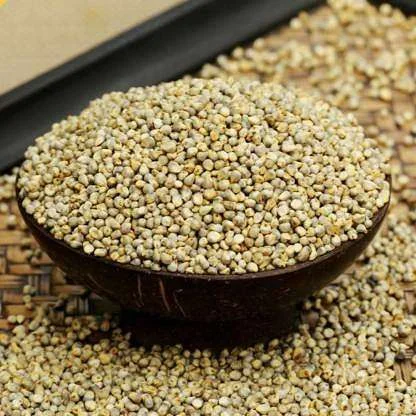
Pearl millet (Pennisetum glaucum), locally known as bajra, is the staple grain of western Rajasthan's arid landscape. The Jodhpur-Pali-Nagaur belt - the heart of the Marwar region - produces some of India's finest bajra, cultivated on sandy-loam soils under rainfed conditions where few other cereals survive. The crop's exceptional drought tolerance, deep root system, and ability to thrive in high temperatures make it a climate-resilient grain for food security and industrial applications alike.
VegTradeHub works directly with farmer collectives across the Marwar region to procure, clean, grade, and export Rajasthani bajra that meets international quality standards. Our supply covers whole grain for flour milling, malted bajra for beverage and nutraceutical use, clean graded grain for animal feed compounders, and processed forms (flour, flakes, puffed) for food manufacturers. Every lot is traceable to farm clusters, tested for moisture, purity, and aflatoxin, and packed in food-grade materials suited for long-distance export. Whether you need a trial container or a full-season program, we deliver consistent bajra quality with complete documentation.
Grown in Rajasthan's Thar Desert margins where heat and low rainfall naturally select for hardy, nutrient-dense grain.
Procured from vetted grower groups in Jodhpur, Pali, Nagaur, and Barmer - full traceability to field level.
Harvested at 12-14% moisture; sun-dried on clean threshing floors to prevent fungal contamination.
Pre-cleaned, de-stoned, magnetic separation, and optical sorting for export-grade purity.
Meets international phytosanitary standards - clean, sound, pest-free, suitable for global markets.
Stored in ventilated, pest-managed godowns; regular fumigation and moisture monitoring.
Graded by test weight, kernel size, purity, and foreign matter to defined commercial specifications.
Available as whole grain, malted, flour, flakes, or puffed - tailored to your end-use requirements.
The Marwar region's hot, arid climate with 250-400 mm annual rainfall and temperatures reaching 45-48°C in summer creates the ideal stress conditions for pearl millet. Pearl millet's C4 photosynthetic pathway and deep fibrous root system (extending 2-3 meters) allow it to extract moisture from sandy soils where wheat or maize would fail. The intense sunlight and diurnal temperature variation during grain filling (October-November) promote dense, heavy kernels with high test weight - a key quality parameter for millers and feed compounders. This natural adaptation means Rajasthani bajra consistently delivers superior grain density and nutritional profile compared to irrigated-region production.
The region's light-textured sandy loams (locally called 'bhuri mitti') with low clay content and excellent drainage prevent waterlogging - critical for a crop sensitive to excess moisture at flowering. Soil pH ranges from 7.5-8.5, slightly alkaline, which suits bajra's preference. Organic carbon is typically low (0.2-0.4%), but traditional farming practices including crop rotation with legumes (moth bean, cluster bean) and application of farmyard manure maintain soil health. The absence of heavy metal contamination in these traditional farming belts supports clean-grain production for food and nutraceutical grades.
Pearl millet cultivation in Marwar spans centuries, with farming communities maintaining landraces adapted to micro-climates across Jodhpur, Pali, Nagaur, Barmer, and Jaisalmer. Farmers follow time-tested practices: dry sowing ahead of monsoon (June-July), intercropping with legumes for nitrogen fixation, and harvesting at physiological maturity when grain moisture drops below 15%. VegTradeHub partners with these experienced growers through pre-season contracts, providing improved seed (hybrids like HHB 67, MPMH 17, RHB 177), guidance on integrated pest management, and assured procurement at fair prices. This relationship ensures variety purity, consistent agronomy, and traceability from specific village clusters.
Jodhpur serves as the primary aggregation and logistics hub for Marwar bajra. The city's railway junction connects to Mundra and Pipavav ports (8-10 hours by road) for sea freight, while Jodhpur and Jaipur airports handle air cargo to the Middle East and Southeast Asia. National Highways NH-62 and NH-25 provide all-weather road access to major consumption centers - Delhi (600 km), Mumbai (950 km), Ahmedabad (450 km). Inland container depots at Jodhpur and Bhagat Ki Kothi facilitate customs clearance near origin. This multi-modal infrastructure allows us to optimize freight mode (road, rail, sea, air) based on buyer urgency, volume, and destination.
| Parameter | Grade A (Premium Food) | Grade B (Standard Food/Feed) | Grade C (Processing/Feed) |
|---|---|---|---|
| Test weight | ≥ 78 kg/hl | 72-78 kg/hl | 65-72 kg/hl |
| Moisture content | 11-12% max | 12-13% max | 13-14% max |
| Purity (clean grain) | 99.5% min | 99.0% min | 98.0% min |
| Foreign matter | 0.1% max | 0.2% max | 0.5% max |
| Other grains | 0.1% max | 0.3% max | 1.0% max |
| Damaged/discolored kernels | 0.5% max | 1.0% max | 2.0% max |
| Immature/shriveled kernels | 1.0% max | 2.0% max | 3.0% max |
| Insect damaged kernels | 0.1% max | 0.5% max | 1.0% max |
| Aflatoxin (B1+B2+G1+G2) | < 4 ppb (EU standard) | < 10 ppb | < 20 ppb |
| Protein content (dry basis) | 11-13% | 10-12% | 9-11% |
| Fat content (dry basis) | 4.5-5.5% | 4.0-5.0% | 3.5-4.5% |
| Packaging | 25 kg / 50 kg PP woven bags; 500 kg / 1000 kg bulk bags; custom | ||
| Country of origin | India | ||
| Port of loading | Jodhpur (air/rail ICD), Mundra / Pipavav (sea) | ||
VegTradeHub offers full private-label packaging services for importers, distributors, and retail chains:
| Parameter | Specification |
|---|---|
| Temperature | Cool, dry conditions (10-20°C optimal; avoid >30°C) |
| Relative humidity | 55-65% (prevents moisture uptake and mold growth) |
| Air circulation | Good ventilation; avoid stagnant humid air pockets |
| Pest management | Regular monitoring; phosphine fumigation or controlled atmosphere as needed |
| Stack height | Max 10 bags high on pallets; bulk bags per manufacturer rating |
| Shelf life (proper storage) | 12-18 months for whole grain; 6-9 months for flour/processed forms |
12-18 months in cool, dry storage (10-20°C, 55-65% RH). Maintains kernel integrity, protein quality, and low FFA (free fatty acid) levels for flour milling and nutraceutical use.
10-12 months under proper storage. Minor increase in FFA over time but suitable for feed compounding and standard food processing throughout.
8-10 months - intended for near-term processing (malting, feed milling, ethanol). Higher initial moisture requires prompt use.
Primary use for whole-grain bajra flour (bajra atta), blended flours (multigrain), and traditional products like bajra roti, bhakri, and khichdi. Uniform kernel size and high test weight give excellent milling yield (75-80% extraction). Low bran contamination from optical sorting ensures clean flour with minimal specks.
Malted bajra (germinated, kilned) is a growing segment for malt-based beverages, health drinks, and weaning foods. Rajasthani bajra's high diastatic power and balanced protein make it suitable for single-grain malt or blends with barley/wheat. We supply cleaned, graded grain optimized for steeping and germination uniformity.
Pearl millet is rich in phenolic compounds, flavonoids, and resistant starch. Food-grade lots are supplied to nutraceutical manufacturers for extraction of antioxidants, dietary fiber concentrates, and gluten-free ingredient systems. High iron and zinc content (vs. rice/wheat) supports fortification applications.
Major volume outlet for Grade B/C bajra. High metabolizable energy (~13.5 MJ/kg for poultry), good protein (10-12%), and favorable amino acid profile (higher lysine than maize) make it valuable in poultry, cattle, and aquafeed formulations. Consistent test weight and low mycotoxin levels support feed mill QC.
Diaspora markets (Middle East, Africa, Southeast Asia) demand whole grain for traditional preparations: bajra porridge, fermented batters, flatbreads, and popped snacks. We supply cleaned whole grain in consumer packs and bulk for ethnic food manufacturers.
Surplus or processing-grade bajra serves as feedstock for grain-based distilleries (ethanol, potable alcohol) and wet milling for starch derivatives. High starch content (65-70%) and consistent quality support fermentation efficiency.
UAE, Saudi Arabia, Qatar, Oman, Kuwait, Bahrain, Jordan, Lebanon. Strong demand for food-grade bajra (traditional flatbreads, porridge) and feed-grade for large poultry/dairy sectors.
Indonesia, Malaysia, Philippines, Vietnam, Thailand. Growing feed industry demand; ethnic food markets for Indian diaspora; emerging malt beverage sector.
Kenya, Tanzania, Uganda, Ethiopia, South Africa, Mauritius, Seychelles. Pearl millet is a staple in Sahel and East Africa; Indian bajra supplements local supply gaps.
Bangladesh, Nepal, Sri Lanka, Bhutan, Maldives. Land and sea connectivity; food processing and feed sectors are key buyers.
Netherlands, Germany, UK, France, Italy. Niche demand for gluten-free millet flour, organic bajra, birdseed, and specialty health food. EU MRL compliance mandatory.
USA, Canada. Growing gluten-free and ancient grains market. Air freight for food-grade; sea freight for feed/processing. USDA APHIS import permit required.
Direct work with grower groups across Jodhpur, Pali, Nagaur, Barmer - full traceability from field to bag.
Track record shipping grains and vegetables to 25+ countries with destination expertise and seasonal reliability.
Standardized grading, documented QC, lot-level traceability, and aflatoxin testing every shipment.
From trial 20 MT containers to full-season 5,000+ MT programs - scalable to your demand profile.
Harvest-to-load discipline: pre-booked container space, priority rail wagons, and ICD slots.
Complete, accurate export documents delivered on time - phytosanitary, COO, COA, fumigation, buyer-specific.
Transparent cost breakdowns - farm gate, cleaning, bagging, transport, documentation - no hidden margins.
Single point of contact per buyer; responsive across time zones with WhatsApp-first communication.
Private label, consumer packs, bulk bags, MAP, eco-friendly - adapted to your market and regulatory needs.
Multi-season supply partnerships with forecast sharing, volume commitments, and forward price contracts.
Trial orders from 20 MT (one 20' container). Full-season programs typically 500-5,000 MT with forward pricing and dedicated acreage.
Yes - full private-label packaging: custom bag artwork, multi-language labels, consumer packs (500g-5kg), retail-ready formats, bulk bags with liners, and MAP options.
Yes - to 25+ countries across Middle East, Southeast Asia, Africa, South Asia, Europe, and North America. We handle all export documentation and compliance.
Grain dried to 11-12% moisture, packed in moisture-barrier lined bags, loaded in clean dry containers with desiccants, temperature/humidity loggers on high-value lots, arrival inspection protocols.
Sea freight (dry/ventilated containers), air freight, rail (ICD-to-ICD), road (regional/SAARC). Mode selected based on volume, urgency, destination, and grade.
Yes - mixed 20'/40' containers combining bajra with other Rajasthan commodities: wheat (gehun), cumin (cumin seeds), fenugreek (methi), coriander, red onion, garlic, and winter vegetables.
Select farms GlobalGAP certified; packhouse operates HACCP-based food safety system. FSSAI Central License, APEDA RCMC registration, residue testing per FSSAI/Codex/EU MRLs. Organic certification available for certified farm lots.
Early booking (May-July) secures best pricing, grades, and dedicated acreage. Forward contracts lock in supply and pricing before monsoon sowing. Harvest arrives September-November.
Claims must be reported within 7 days of arrival with photo evidence, lab reports, and logger data. We investigate within 48 hours and resolve within 10 business days per contract terms.