
Natural growing conditions
Cultivated across Punjab, Haryana, UP, West Bengal and peninsular regions - cool winters and moisture produce well-formed roots.
VegTradeHub supplies carefully sourced fresh radish (Raphanus sativus) from trusted farms across Punjab, Haryana, Uttar Pradesh and other prime growing belts. White varieties (Pusa Chetki, Pusa Desi, Japanese White), pink types (Chinese Pink, Red Globe) and daikon/mooli types are freshly harvested, professionally graded and hygienically packed according to export requirements.
| Parameter | Specification |
|---|---|
| Common name | Radish, Mooli, Mula, Daikon (long white types) |
| Botanical name | Raphanus sativus L. |
| Category | Fresh root vegetable |
| Origin | India (Punjab, Haryana, Uttar Pradesh, West Bengal, Bihar, Madhya Pradesh, Maharashtra, Karnataka, Tamil Nadu) |
| Available forms | Fresh whole roots (table grade, processing grade) |
| Growing regions | Punjab (Jalandhar, Ludhiana); Haryana (Hisar, Karnal, Sonipat); UP (Meerut, Aligarh); WB (Hooghly, Burdwan); Bihar (Nalanda); MP (Indore); Maharashtra (Pune, Nashik); Karnataka (Kolar); Tamil Nadu (Nilgiris) |
| Harvest season | Rabi main crop: November–March (peak Dec–Feb); Kharif crop: June–September (select regions); year-round in peninsular cool zones |
Radish is a fast-maturing root crop of the Brassicaceae family. India grows white, pink and long daikon/mooli types across diverse agro-climatic zones for both domestic and export markets.
Table radish is harvested young for crisp texture; daikon and processing types mature larger for slicing, fermentation and fresh-cut applications.
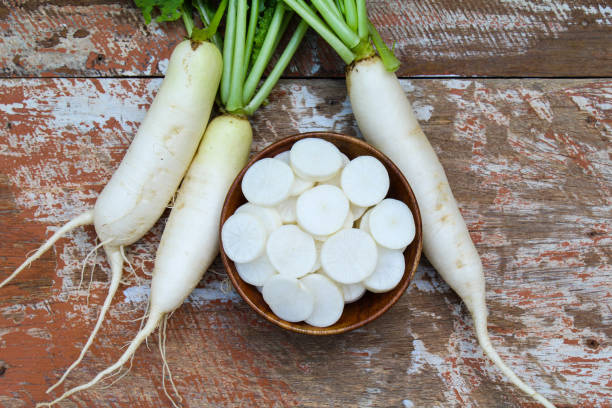
Cultivated across Punjab, Haryana, UP, West Bengal and peninsular regions - cool winters and moisture produce well-formed roots.
Sourced from trusted growers who follow good agricultural practices, use quality seed and maintain traceability records.
Roots freshly harvested at optimal maturity - when size, shape and internal quality meet variety standards.
Each lot professionally graded for uniform diameter, length, weight, skin finish and freedom from defects, cracking, pithiness and mechanical damage.
Quality checked before dispatch for size uniformity, skin integrity, internal quality, pungency and freedom from pests and diseases.
Coordinated harvest schedules from multiple belts ensure continuous availability through Rabi (Nov-Mar) with Kharif (Jun-Sep) in select regions.
Rapid post-harvest handling, hygienic sorting and packing, and cold-chain management maintain root firmness and storage potential during transit.
Clean, well-shaped roots with smooth skin and consistent color within variety; graded sizing for table or processing markets.
India's range of agro-climatic zones supports radish in tropical, subtropical and temperate conditions. Northern plains produce the main Rabi crop; eastern states extend the harvest window; peninsular zones supply cooler pockets year-round.
Highway corridors (NH-1, NH-44, NH-19, NH-27, NH-48), rail terminals, packhouse networks and proximity to ports (Mundra, Pipavav, JNPT, Kolkata, Chennai) support consistent bulk and export supply.
| Parameter | Specification |
|---|---|
| Northern plains | Punjab, Haryana, UP — main Rabi crop (Nov–Mar) |
| Eastern deltaic | West Bengal, Bihar — extended harvest window |
| Central India | Madhya Pradesh, Maharashtra — regional hubs |
| Peninsular zones | Karnataka, Tamil Nadu, Nilgiris — cool-season pockets |
| Highway corridors | NH-1, NH-44, NH-19, NH-27, NH-48 for reefer transit |
| Export ports | Mundra, Pipavav, JNPT, Kolkata, Chennai |
| Parameter | Specification |
|---|---|
| Product | Fresh radish (Raphanus sativus L.) |
| Common names | Radish, Mooli, Mula, Daikon (long white types) |
| Category | Fresh root vegetable |
| Origin | India (Punjab, Haryana, Uttar Pradesh, West Bengal, Bihar, Madhya Pradesh, Maharashtra, Karnataka, Tamil Nadu) |
| Available forms | Fresh whole roots (table grade, processing grade) |
| Growing regions | Punjab (Jalandhar, Hoshiarpur, Ludhiana); Haryana (Hisar, Karnal, Sonipat); UP (Meerut, Aligarh, Hathras); WB (Hooghly, Burdwan, Nadia); Bihar (Nalanda, Patna); MP (Indore, Ujjain); Maharashtra (Pune, Nashik); Karnataka (Bangalore Rural, Kolar); Tamil Nadu (Nilgiris, Dindigul) |
| Harvest season | Rabi main crop: November-March (peak Dec-Feb); Kharif crop: June-September (select regions); Year-round in peninsular cool zones |
| Grade | Export Grade A / Class I (as per UNECE FFV-39 / Indian standards); Table Grade; Processing Grade |
| White varieties | Pusa Chetki, Pusa Desi, Japanese White, White Icicle, Rapid Red White Tip |
| Pink / red varieties | Chinese Pink, Red Globe, Scarlet Globe, Sparkler, French Breakfast |
| Daikon / mooli types | Local long white varieties (Mino Early, Miyashige types), Pusa Chetki Long |
| Skin color | White (most varieties); Pink to red (colored varieties); Creamy white (daikon) |
| Flesh color | White (all varieties); Crisp, juicy texture |
| Root diameter (table) | 30-50 mm (uniform within grade) |
| Root diameter (daikon/processing) | 40-80+ mm diameter; 20-40 cm length for daikon types |
| Root length (table) | 5-10 cm (globular); 10-15 cm (cylindrical) |
| Root length (daikon) | 25-45 cm |
| Defects tolerance | Free from decay, cracking, pithiness, hollowness, cuts, bruises, mechanical damage, pest damage, disease, doubles/multiples |
| Foreign matter | Nil |
| Top condition | Fresh green tops attached (bunched) or topped per buyer specification; topped roots trimmed clean |
| Shelf life | Table (topped): 1-3 weeks under proper cold storage; Daikon: 2-4 weeks under proper cold storage; Bunched: 5-7 days refrigerated |
| Packaging | Ventilated CFB cartons (5/10/15 kg); PP mesh bags (10/20/25 kg); Bunched in crates; Bulk bins for processing |
| Origin certification | Certificate of Origin, Phytosanitary Certificate (on request), GLOBALG.A.P./IndiaGAP records (where available) |
Meets international quality standards for fresh radish, suitable for cross-border shipment and premium domestic programmes.
Consistent root diameter and length within each grade for predictable yields and pack-weight uniformity.
Clean skin, smooth finish, well-shaped roots with no blemishes - meeting the visual bar of premium buyers.
Picked at optimal maturity for maximum storage potential and consistent internal quality.
Mechanically and hand-sorted to remove defects, off-grade roots and any produce not meeting buyer specification.
Trained graders classify by size, shape, skin finish and internal quality for reliable lot consistency.
Food-grade packaging materials and clean packhouse environment protect root quality and meet export food-safety norms.
Variety-appropriate texture and pungency for table or processing use, validated through internal quality checks.
Preferred by pickle processors, retailers and food-service buyers for appearance, flavour and storage performance.
Robust root structure withstands reefer shipping with appropriate pre-cooling and humidity management.
Farm, packhouse and pre-loading checks verify every lot before release for export or domestic wholesale.
Farm-level records maintained for export documentation and quality investigation when required.
Standard for premium table grades. Stackable, protects roots, allows airflow. Custom printing available.
Cost-effective for processing and daikon grades. Good ventilation, durable for handling.
Fresh tops attached for premium fresh market. Ventilated plastic/wood crates maintain turgidity.
For large-volume processing buyers. Forklift compatible, reduces handling.
Perforated film liners inside cartons for extended shelf life on long transits. Available on request.
Private label, specific carton artwork, language labeling, barcode/QR coding per buyer requirements.
1–3 weeks at 0–2degC with 95–98% RH under proper post-harvest handling.
2–4 weeks at 0–1degC with 95–98% RH under proper handling and packaging.
5–7 days refrigerated at 0–2degC; leaves wilt quickly and pull moisture from roots.
2–4 days at 15–20degC; roots lose crispness above 25degC.
10–14 days sea freight in reefer at 0–2degC; 3–5 days air freight.
5–10 days from harvest to processing for slicing, fermentation and pickling.
White and pink varieties preferred for traditional Indian pickles, Korean kimchi and Japanese takuan. Crisp texture retained through processing.
Table grades for supermarkets, wet markets and vegetable vendors. Uniform sizing, clean skin and fresh appearance drive consumer selection.
Consistent sizing and quality for restaurants, hotels, catering and institutional kitchens. Daikon for Asian cuisine; table radish for salads.
Daikon and white varieties suitable for air-drying, freeze-drying and powder production for seasoning blends, soup bases and nutraceuticals.
Uniform roots for shredded, julienne and matchstick cuts. High yield, minimal waste; white varieties preferred for visual appeal.
Middle East, Southeast Asia, South Asia, Europe and North America (ethnic markets).
UAE, Saudi Arabia, Qatar, Oman, Bahrain, Kuwait - retail and HORECA supply via Mundra and JNPT.
Singapore, Malaysia, Thailand, Indonesia, Philippines - ethnic food, fresh-cut and pickle processor supply.
Bangladesh, Sri Lanka, Nepal, Bhutan - cross-border road and short-sea reefer supply via Kolkata/Haldia and Petrapole.
UK, Germany, Netherlands, France - Asian diaspora retail, fresh-cut processors and fermentation industry.
USA, Canada - daikon and specialty radish programmes via air and sea; ethnic distributor networks.
Kenya, Tanzania, South Africa, Mauritius; Japan, South Korea, Hong Kong - high-pungency table and processing grades.
Established logistics networks across India's radish belt, working with contracted growers in multiple states.
White, pink and daikon types matched to market needs - Pusa Chetki, Japanese White, Chinese Pink and local mooli available.
HACCP-aligned facilities with cold-chain infrastructure, optical sizing, variety segregation and humidity-managed storage.
Cartons, mesh bags, bunched crates, bulk bins and custom branding supplied per buyer specification.
Mundra, Pipavav, JNPT, Kolkata, Chennai and air-cargo hubs allow destination-optimized routing.
Phytosanitary, Certificate of Origin, GlobalGAP and organic certificates managed in-house for smooth customs clearance.
Combine radish with carrot, beetroot, turnip, cabbage, onion and garlic in one reefer for cost-efficient procurement.
Detailed CIF/CFR/FOB offers within 4-6 business hours (IST) with crop updates, loading photos and shipment tracking.
Farm audits, packhouse QC, pre-loading inspections and temperature logs safeguard every shipment.
Standard MOQ is 20-24 MT (one 40' reefer at 24-26 MT). Air freight from 1 MT minimum; LCL reefer consolidation available at 5-12 MT for trial orders.
Yes. We source Pusa Chetki, Pusa Desi, Japanese White, White Icicle, Chinese Pink, Red Globe and local daikon/mooli varieties from contracted farms with variety identity maintained through loading.
We serve buyers in the Middle East, Southeast Asia, South Asia, Europe, North America, East Asia and Indian Ocean islands. Other destinations assessed on request.
Harvest at optimal maturity, variety-appropriate storage temperature (0-2degC), ventilated packaging, pre-cooled reefers, temperature/humidity loggers in every shipment and ethylene management.
Sea freight reefer (10-30 days) from Mundra, Pipavav, JNPT, Kolkata, Chennai; air freight (1-3 days) from DEL, BOM, ATQ; rail/road reefer to Nepal, Bangladesh, Bhutan; LCL reefer consolidation for smaller orders.
Yes. We ship mixed loads - radish with carrot, beetroot, turnip, cabbage, cauliflower, onion, garlic - optimized for container weight (24-26 MT) and temperature compatibility (0-2degC).
Packhouse partners operate under HACCP and growers hold GLOBALG.A.P. / IndiaGAP where available, complying with destination-country MRL and phytosanitary requirements.
Quotes on CIF / CFR / FOB basis in USD or INR. Standard terms: 30% advance on PO confirmation, 70% against copy of shipping documents; LC at sight for new buyers.
Share your requirements via WhatsApp (+91 6375273283) or our contact form: destination port, monthly volume, variety/grade, size grade, pack style and shipment window. We respond within 4-6 hours during business hours (IST).
VegTradeHub responds to serious B2B enquiries with sourcing availability, variety guidance, packing options and wholesale pricing.